
With DDR5 memory prices remaining high, do gaming players really need to pay substantially more for a new platform? Using VALORANT as a case study, this article combines testing by a former professional VALORANT player with CPUBenchmark.net (PassMark Software) CPU data to examine the performance, budget, and use cases of i7-14700K + DDR4 3200 U-DIMM versus Ryzen 7 7800X3D + DDR5, while reconsidering the product-mix value of DDR4 and SSD from the perspective of system integrators, agents, and distributors.
Table of Contents
Toggle
In competitive FPS games such as VALORANT, players often equate a higher average FPS with a better gaming experience. As DDR5 becomes increasingly mainstream, many PC builders naturally view Ryzen 7 7800X3D + DDR5 as the standard high-FPS platform.
But for a budget-conscious gaming PC, the more important question is: does the extra spending translate into a difference that the display can actually show and the player can actually feel?
That is the focus of this test. The system was tested by a former professional VALORANT player who previously represented the Taiwan-Hong Kong-Macau region. Known as rkgk (axiongk1ng), he tested an Intel Core i7-14700K, DATO DDR4 3200 U-DIMM memory, and an RTX 5070, then provided his concluding observations and gaming impressions based on actual gameplay. This was a test-based evaluation, not an interview.
Core Question If the monitor refresh rate is 240Hz and the system can already sustain more than 300 FPS, is it really necessary to increase the budget substantially for a DDR5 platform? |
The test shows that during normal matches, dense ability effects, and scenes with heavy on-screen information, the i7-14700K with DATO DDR4 3200 U-DIMM and RTX 5070 can maintain around 300 FPS. In late-round or one-on-one situations with a lighter visual load, FPS can remain around 400 FPS.
Based on the player’s real-world experience, around 350 FPS in VALORANT is already enough to provide a very smooth experience for most players. This suggests that once a system can consistently deliver frame rates above the needs of common high-refresh-rate displays, the practical benefit of pursuing even higher average FPS may gradually diminish.
The same observation extends to other popular shooters. In the battle-royale title Apex Legends, the i7-14700K + DDR4 3200 U-DIMM + RTX 5070 configuration can also sustain around 250–300 FPS at 1080p with high graphics quality settings. Compared with judging a platform through a single-game benchmark alone, this cross-game test provides a more practical view of the value of a DDR4 platform in real gaming PCs and esports systems.
The significance of these results is not that DDR4 is faster than DDR5. Rather, they show that for mainstream high-refresh-rate gaming monitors, a DDR4 platform can still provide substantial FPS headroom.
Real-World Scenario | i7-14700K + DDR4 3200 U-DIMM + RTX 5070 | What It Means for Players |
Dense ability effects, multiple-player combat | Around 300 FPS | Enough to cover the needs of a 240Hz display |
Late-round, one-on-one, simpler scenes | Around 400 FPS | Provides additional FPS headroom |
Platform Positioning | Cost-focused, strong multitasking capability | Suitable for budget gaming PCs and streaming/creative workloads |
Professional Player Test Highlight With this configuration, DDR4 does not reduce VALORANT to a level where low graphics settings are the only practical option. Instead, the system can still maintain around 300 FPS in high-intensity matches, showing that platform selection should be evaluated together with monitor specifications, budget, and actual workload. |
If we look only at gaming performance, the Ryzen 7 7800X3D still has a clear advantage. Results vary by test platform and scenario, but public benchmark data generally shows that the 7800X3D delivers higher average FPS in CPU-limited gaming scenarios and is more purpose-built for gaming.
The VALORANT public test data summarized in this article is approximately 881 FPS versus 771 FPS, putting the 7800X3D about 14% ahead. In aggregated testing across more than 100 games, the 7800X3D shows an average gaming performance advantage of around 17% over the i7-14700K. These figures should be interpreted as performance trends rather than absolute FPS values that can be reproduced on every system.
Comparison | i7-14700K | Ryzen 7 7800X3D |
Gaming Positioning | High-performance all-around CPU | X3D platform focused on gaming performance |
VALORANT Trend | Around 771 FPS (aggregated testing) | Around 881 FPS (aggregated testing) |
Streaming / editing / multitasking | Stronger advantage | Gaming first |
Power Profile | Higher | Lower |
Memory Platform | DDR4 / DDR5 (depending on motherboard) | DDR5 / AM5 platform |
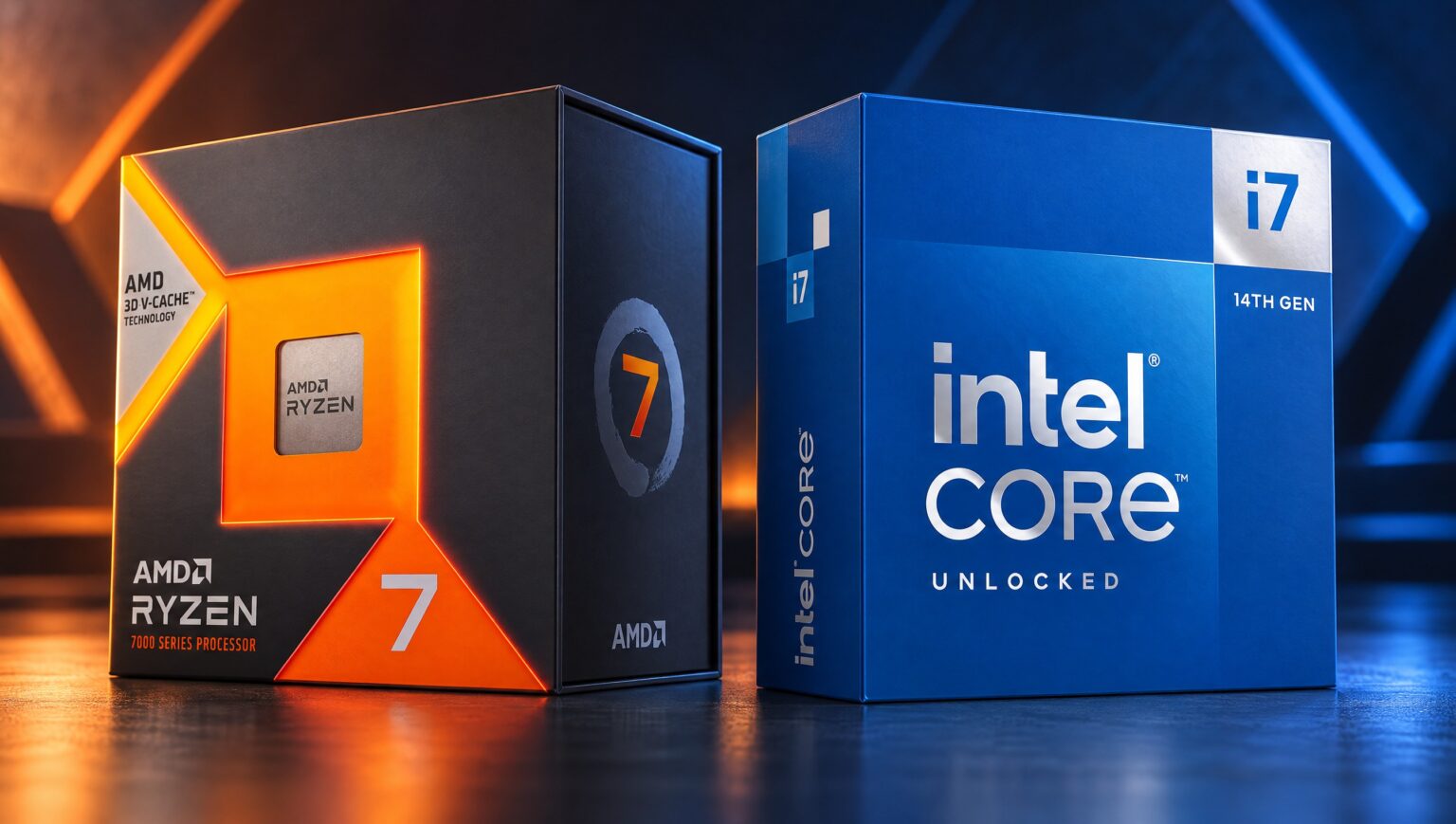
CPU Benchmark reference: According to CPUBenchmark.net (PassMark Software), as of October 2, 2026, the i7-14700K scores 51,920 on CPU Mark versus 34,279 for the 7800X3D. Single Thread Rating is 4,454 versus 3,759. The i7-14700K is about 51% higher in CPU Mark and about 18% higher in single-thread performance. These figures are provided as a supplementary reference for overall CPU compute and multitasking capability, not as a direct measure of VALORANT FPS.
Benchmark Metric | Intel Core i7-14700K | AMD Ryzen 7 7800X3D |
CPU Mark* | 51,920 | 34,279 |
Single Thread Rating* | 4,454 | 3,759 |
For gamers, performance differences are often the easiest figures to understand. For system builders, agents, and distributors, however, BOM cost is often what determines the product mix. In a market with visible memory price volatility, the price gap between DDR4 and DDR5 can directly change the target price positioning of a complete system.
Using publicly available U.S. retail pricing from September 2026 as a reference, 32GB DDR5 was notably more expensive than DDR4. Actual retail prices can change quickly depending on brand, frequency, timings, promotions, and channel. The figures below should therefore be treated as market ranges rather than fixed quotations.
Item | DDR4 Platform Reference | DDR5 Platform Reference |
32GB Memory | Approx. US$129–233 | Approx. US$429–560 (varies by specification/channel) |
CPU Reference | i7-14700K around US$360 (channel dependent) | 7800X3D around US$334–416 (promotion dependent) |
Estimated CPU + 32GB RAM | Approx. US$490–595 | Approx. US$760–975 |
Overall Cost Relationship | Lower | Approx. 1.5–1.6x the former |
Cost Perspective Based on the estimates in this article, the gap between the two configurations is approximately US$270–480. Using the midpoint as a reference, roughly US$300 could be reallocated to an SSD, display, GPU, or other components. |
A gaming PC rarely performs just one task. For content creators, streamers, and esports players, it is common to game while running a stream, recording, a browser, voice communication, or video-editing software. In these scenarios, overall CPU multi-core capability and workload performance should not be reduced to a single FPS number.
The i7-14700K’s core and thread configuration gives it a practical advantage in multitasking workloads, which is consistent with the CPU Mark and Single Thread Rating results from CPUBenchmark.net. For users who game while streaming, recording, browsing, and editing, the value of 14700K + DDR4 3200 U-DIMM is not simply spending less; it is using the budget to build a more balanced overall system.
Use Case | Better Fit | Reason |
Pure VALORANT high FPS | 7800X3D + DDR5 | Pursue higher gaming performance and minimum FPS |
300Hz or below | 14700K + DDR4 3200 U-DIMM | Sufficient FPS headroom at lower cost |
Gaming + streaming + multitasking | 14700K + DDR4 3200 U-DIMM | Better suited to all-around workloads |
360Hz+ competitive display | 7800X3D + DDR5 | At 360Hz and above, higher frame rates can be utilized more effectively, making FPS consistency and 1% low performance more valuable. |

For system integrators and channel customers, the value of DDR4 is not simply that it costs less. Its real value is the ability to control complete-system BOM costs without sacrificing gaming performance excessively, allowing products to compete across a broader mainstream gaming price range.
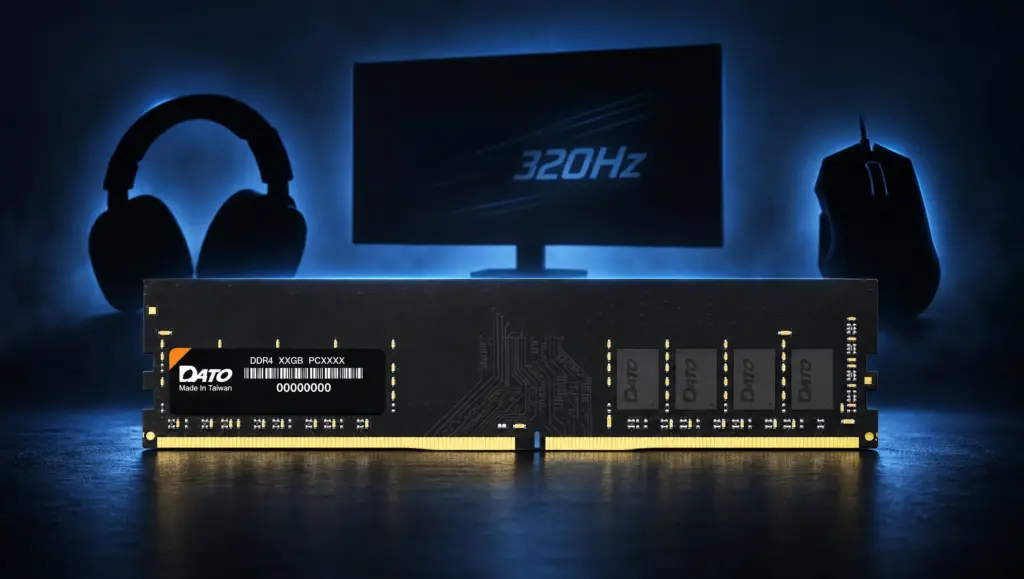
DATO DDR4 3200 U-DIMM Desktop Memory is available in 3200 / 3600 MHz options and can be configured according to the CPU, motherboard, and product positioning. For cost-efficient Gaming PC, OEM, System Integrator, and regional channel product lines, DATO DDR4 is a practical DDR4 3200 U-DIMM desktop memory SKU to keep in the portfolio.
From supply chain management to quality control, DATOTEK maintains long-term relationships with multiple upstream memory manufacturers. Through stable sourcing channels and disciplined procurement management, we secure a reliable supply of high-quality memory wafers and ICs. By integrating product development, packaging and testing, and rigorous quality control, DATOTEK turns memory and SSD components into stable, reliable end products, delivering PC memory, DDR4 3200 U-DIMM memory, and high-performance storage solutions for customers worldwide.
B2B Purchasing Perspective
For agents and distributors, the same gaming market can contain both customers who pursue maximum FPS and customers who prioritize the best total-system price. Keeping a DDR4 3200 U-DIMM product line allows channels to cover more price tiers without forcing every product onto a higher-cost DDR5 platform.
The answer is actually simple: do not look only at the CPU model or the memory generation. Start with the monitor, then the game, and finally the total system budget.
Monitor / Need | Recommended Platform | Purchasing Approach |
≤ 320Hz, budget constrained | i7-14700K + DDR4 3200 U-DIMM | Allocate budget to the SSD, GPU, or display |
≤ 320Hz, streaming / editing | i7-14700K + DDR4 3200 U-DIMM | Balance gaming and multitasking at a more favorable system cost |
360Hz+ display, prioritizing 1% lows | 7800X3D + DDR5 | High refresh rates can make better use of additional FPS, making frame-rate stability more important. |
Seeking platform upgrade headroom | DDR5 / newer platform | Accept higher initial BOM for a newer platform path |
If we look only at VALORANT FPS, 7800X3D + DDR5 is faster. There is no need to dispute that. But for most players using displays at 240Hz or below, i7-14700K + DDR4 3200 U-DIMM can already deliver enough FPS for high-refresh-rate competitive gaming.
What matters is the relationship between the performance gap and the cost gap. If a DDR5 platform can raise system costs to roughly 1.5–1.6 times a DDR4 configuration, that additional spending may not deliver an equivalent improvement in real-world experience for budget-oriented gaming systems.
For brands, system integrators, agents, and distributors, this also suggests a more practical product strategy: segment product lines by DRAM generation and reallocate the savings toward SSDs, GPUs, or displays to build a complete portfolio from entry-level to high-end systems.
The professional player test data, usage scenarios, and product positioning in this article are based on the test information provided for this project. CPUBenchmark.net (PassMark Software) data is provided as a third-party CPU benchmark reference for comparing overall and single-thread performance and does not represent specific VALORANT FPS performance. Public CPU and DRAM prices vary by region, brand, capacity, speed, timings, promotions, and supply conditions; the prices in this article are references for the U.S. market in September 2026 and do not represent DATOTEK quotations.
Reference 1 (AMD Ryzen 7 7800X3D official product page): View source
Reference 2 (Intel 13th/14th Gen desktop processor stability information): View source
Reference 3 (U.S. memory pricing trends, September 2026): View source
Reference 4 (U.S. RAM pricing summary, September 2026): View source
Reference 5 (CPUBenchmark.net / PassMark Software: Intel Core i7-14700K vs. AMD Ryzen 7 7800X3D):View source


DATOTEK INTERNATIONAL CO., LTD.
3F, No. 34, Alley 18, Lane 478, Ruiguang Rd., Taipei City 11492, Taiwan
TEL: +886-2-2658-1268
Email: datotek@datos.com.tw