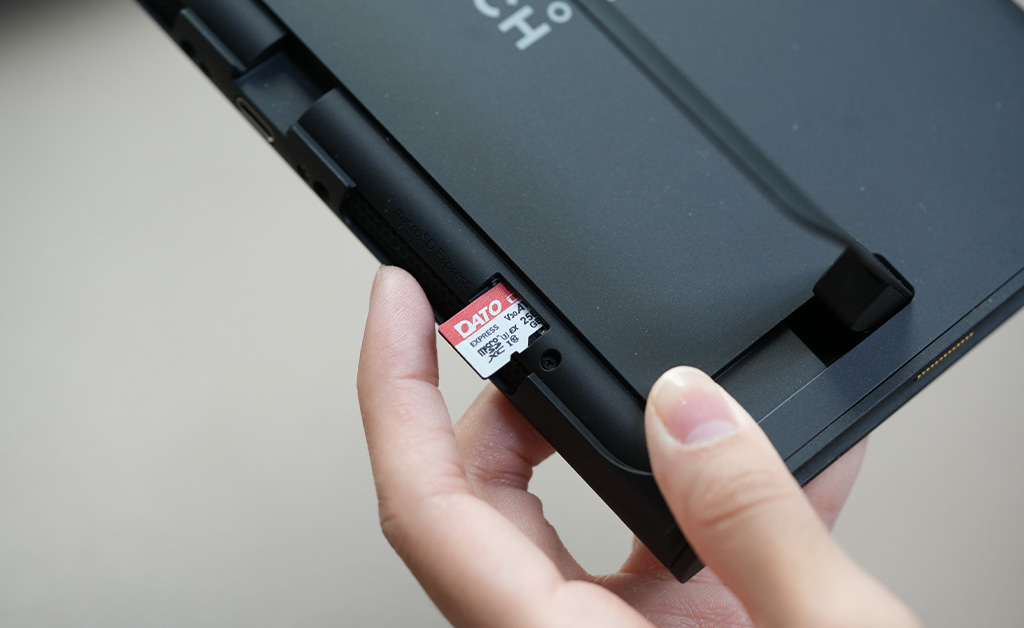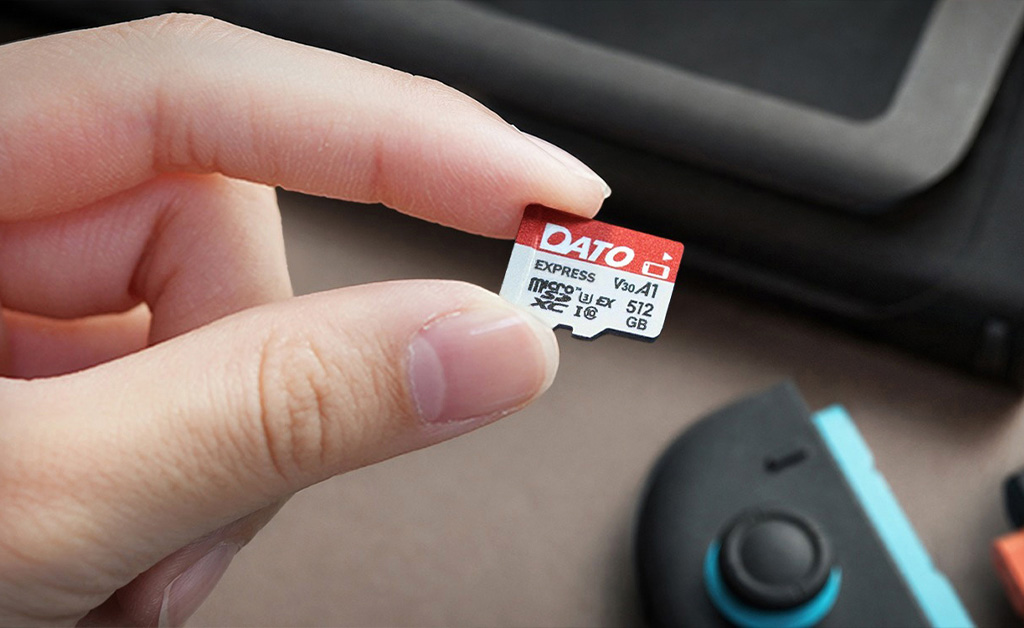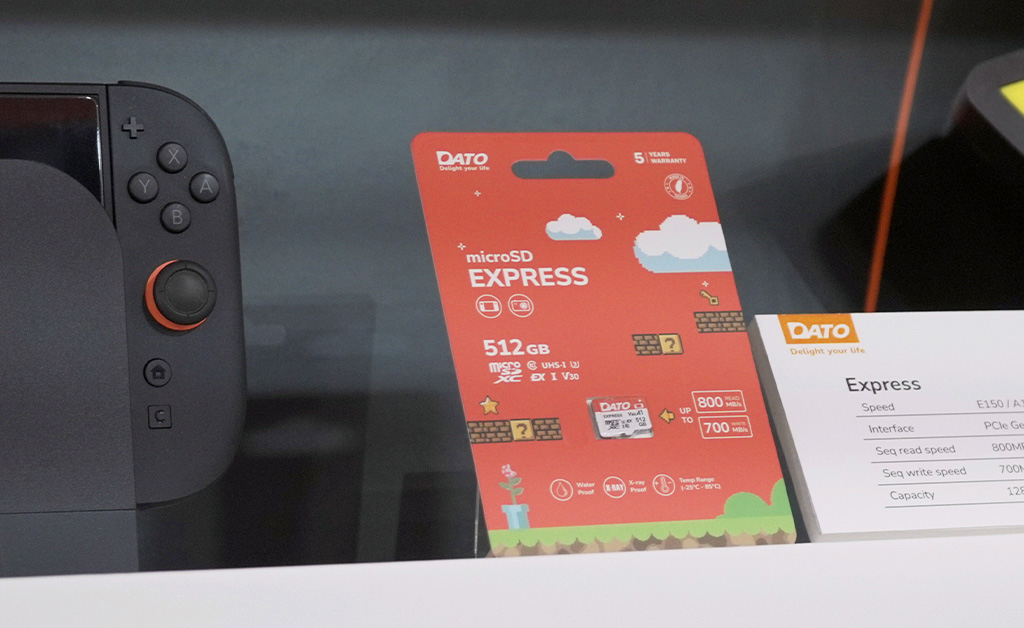
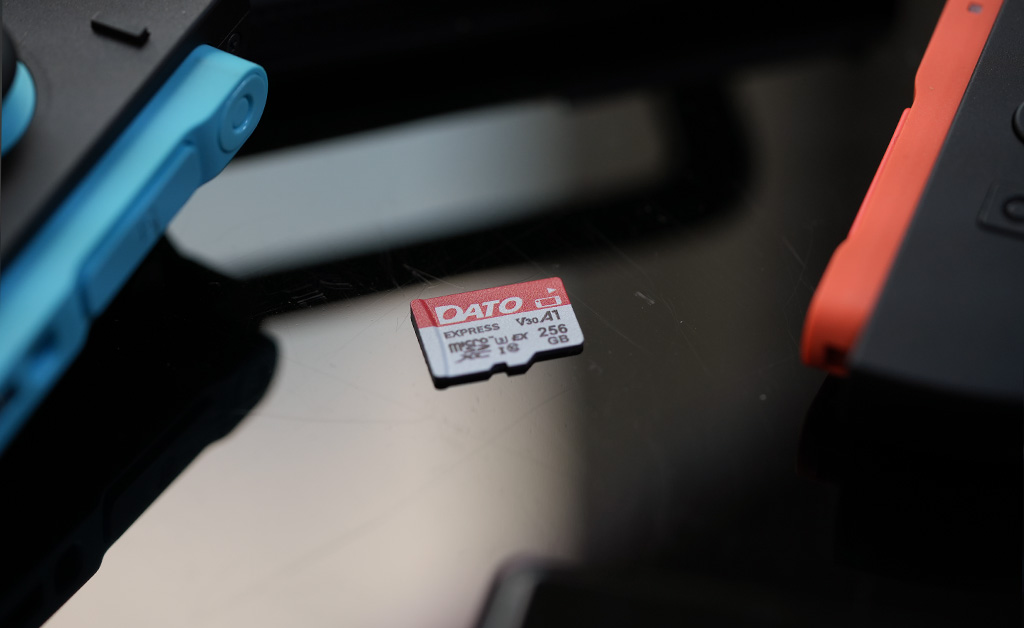

To meet this demand, Datotek offers a microSD Express card line engineered specifically for the PCIe/NVMe standard Switch 2 requires. Here’s the full spec sheet:
| Spec | Detail |
|---|---|
| Interface | PCIe Gen3x1 NVMe / UHS-I |
| Speed Class | E150 / A1 / Class 10 / U3 / V30 |
| Capacity | 128GB / 256GB / 512GB |
| Voltage | 2.7V ~ 3.6V |
| Max Sequential Read | 800MB/s |
| Max Sequential Write | 700MB/s |
While the microSD Express format tops out around 900MB/s in theory, real-world performance depends heavily on controller quality and firmware tuning. DATO’s tested 800MB/s read / 700MB/s write speeds sit close to that ceiling — numbers that actually translate into faster load times on a Switch 2, not just a spec sheet claim. With 128GB, 256GB, and 512GB capacity options, the lineup covers everything from casual players to heavy digital-library collectors, giving distributors flexibility to match inventory to their local market.
Beyond raw performance, DATO’s approach is built around three things B2B buyers care about most:
- Verified compatibility — Tested specifically against the Switch 2 platform to prevent the returns and support tickets that come from “wrong format” purchases.
- Full capacity coverage — 128GB, 256GB, and 512GB options let distributors build assortments suited to different customer segments, from budget-conscious buyers to serious collectors.
- Reliable supply — In a period of tightening DRAM and NAND flash supply and stretched lead times industry-wide, DATO’s established supply chain and inventory management help distributors secure consistent stock during a format transition where information is still asymmetric.
For distributors, microSD Express is still in its brand-awareness phase — consumers don’t yet have a strong preference for which manufacturers actually deliver on the Express spec. That makes now the window to build channel trust before the category matures.